Roller Conveyors
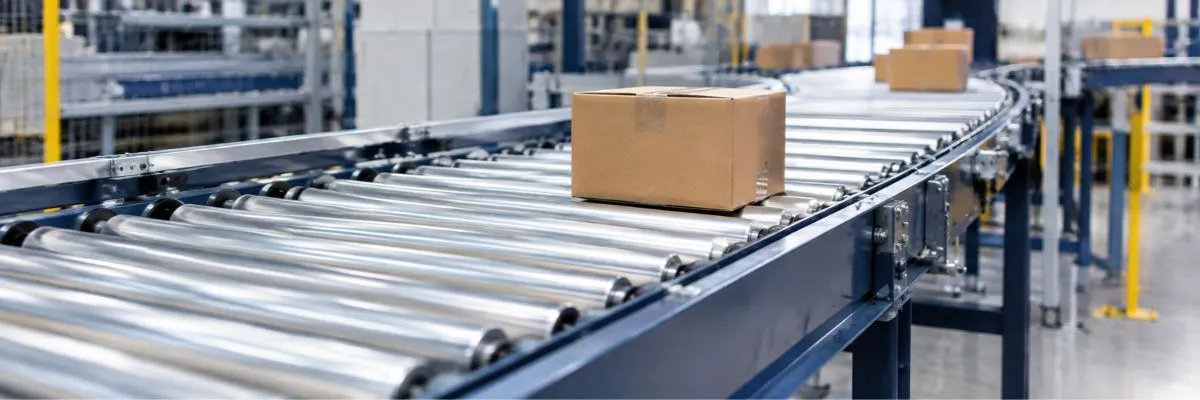
Heavy loads, high throughput and repetitive handling: moving goods around a workshop or warehouse can put strain on operators and slow down production when the equipment is not suited to the task.
Roller conveyors provide a direct solution to this challenge. Using a series of rollers that support and move loads through direct contact, these conveyors can handle the weight of pallets and cartons in applications where other material handling systems may struggle.
Ouest Convoyeur & Automatisme (OCA) has been designing and manufacturing roller conveyors in France for over 45 years. Our solutions include non-powered, powered and gravity roller conveyors, tailored to your production process.
Non-powered or powered roller conveyors: which should you choose?
The choice is not simply about technology; it depends on your material flow, required throughput, load weights and whether you need to automate your production process.
If your aim is to keep investment costs down at a specific workstation or on a low-throughput line, a non-powered solution is generally sufficient. When continuous throughput, variable operating speeds, smooth load accumulation or transfers are required, a powered solution becomes the preferred option.
There are also situations where an elevated conveyor cannot be installed, such as a receiving dock or a transfer point between two trolleys. In these cases, a low-profile, floor-level gravity roller conveyor addresses an installation constraint rather than a throughput requirement.
OCA helps you select the right solution based on your throughput, load characteristics and production line layout constraints.
OCA powered roller conveyor for the food processing industry
Our roller conveyors
Non-powered roller conveyors
On this type of conveyor, the rollers rotate freely under the weight of the load or when pushed manually. This simple, cost-effective solution is suitable for sorting stations, storage areas, unloading operations and buffer zones between production stages.
OCA non-powered roller conveyor for the food processing industry

OCA Gravity Roller Conveyor for the Food Industry
Powered roller conveyors
Equipped with a motorised drive positioned at the end of the line or centrally, these conveyors are suitable for continuous-flow production lines and controlled accumulation applications.
They can also handle transfers and zoning by grouping rollers into independent zones. This allows products to move in a controlled manner and prevents them from coming into contact with one another. This operating principle reduces the pressure exerted on conveyed products.

OCA Powered Roller Conveyor for the Food Industry
Floor-level gravity roller conveyors
This low-profile, compact system is installed directly on the floor, without an elevated support structure. It can easily be integrated between two workstations or connected to a trolley in areas where overhead conveying is not feasible.
Every configuration is custom-designed to meet your specific requirements, including roller diameter and material, track width, load capacity and conveyor length.
Technical specifications
Discover the main specifications of our roller conveyors, designed to suit a wide range of industrial layouts and operating constraints.
Specifications | Options and capabilities |
Roller diameter | Ø 30 mm, Ø 50 mm ou Ø 80 mm |
Roller pitch | Adapted to the dimensions and weight of the products being conveyed |
Roller materials | Zinc-plated steel, PVC or stainless steel |
Load capacity | Determined according to the load per roller, the load per linear metre and the conveyor configuration |
Conveying width | Adapted to the dimensions of the products being conveyed and your installation constraints |
Conveyor length | Standard dimensions or custom design |
Drive system | Tangential chain drive, belt drive or powered rollers |
Applications and industries
Roller conveyors can be integrated into a wide range of industrial environments:
- Logistics: facilitate goods receiving, pallet unloading and order preparation.
- Food processing: integrate into packaging lines to optimise the movement of bins and cartons around operators.
- Automotive: supply workstations ergonomically and simplify the transfer of components between production areas and cells.
- Other industries: optimise material handling between production stages while helping reduce the risk of work-related musculoskeletal disorders (MSDs).
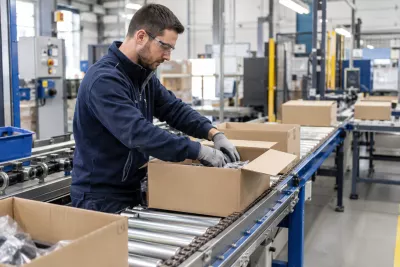
The robust design and accumulation capabilities of roller conveyors make them particularly suitable for high-throughput flows and heavy loads, where other conveyor types, such as belt or chain conveyors, may reach their limits.
OCA, a French manufacturer of industrial conveyors for over 45 years
For over 45 years, OCA has developed recognised expertise in the design and manufacture of bespoke conveying solutions. Our roller conveyors are designed, manufactured and assembled in France, taking applicable regulatory requirements into account and meeting the needs of a wide range of industrial environments.
Unlike standardised catalogue solutions, every OCA installation is custom-designed to meet your actual operating constraints, including load characteristics, throughput, layout and production environment.
Frequently asked questions about roller conveyors
A roller conveyor moves loads along a series of rotating cylinders (rollers) on which the goods rest directly. Movement can be generated by gravity, manual pushing or a powered drive. In powered systems, the rollers are driven by belts or chain loops to move the loads along the line.
A non-powered roller conveyor has no active drive system: loads move through gravity or manual pushing. A powered roller conveyor actively drives the rollers using a motor or motorised roller, making it suitable for continuous throughput and load accumulation.
The choice depends on the weight of each item, the roller diameter and the selected roller pitch. The heavier the load, the more carefully the roller diameter, spacing and load capacity must be dimensioned.
A floor-level gravity roller conveyor moves loads along freely rotating rollers using gravity or manual pushing, without a motorised drive system.
Rollers can be made from zinc-plated steel, PVC or stainless steel, depending on hygiene requirements, corrosion resistance and the loads to be supported.
Track width varies according to the type of load being conveyed, such as bins, cartons, octabins or pallets. Pallet conveying requires specific track widths and load capacities, which must be determined according to the pallet dimensions being used.
Your project, our expertise
Every production line has its own constraints. Our teams support you from the initial assessment of your requirements through to the installation of your roller conveyor, whether you need a non-powered, powered or floor-level gravity solution.