Les convoyeurs à chaîne

La place des convoyeurs dans l’industrie
Le secteur industriel exige d’important besoins de manutention et transfert de charges. Les espaces de production s’étendent bien souvent sur de grandes surfaces, et rendent la manipulation ou le transport de pièces plus laborieux pour les opérateurs. C’est dans ce contexte peu productif et peu ergonomique que les convoyeurs, aériens ou au sol, ont trouvé leur place. Ils ont alors permis d’améliorer les conditions de travail des opérateurs et d’augmenter les flux de production des industries.
Remarquons qu’il existe différents types de convoyeurs : à bande, à rouleaux, à chaîne, à corde, à courroie, etc. Découvrons plus en détails le convoyeur à chaîne.
Qu’est-ce qu’un convoyeur à chaîne ?
Comme précisé dans son nom, ce convoyeur est doté d’une ou plusieurs chaînes selon les spécificités du convoyage recherché. La chaîne de ce type de machine peut être de matière variée : plastique, acier ou inox. Le convoyeur à chaîne peut avoir différents types de chaîne :
- Chaîne à douilles (permettant de transporter des charges à vitesse réduite)
- Chaîne à rouleaux
- Chaîne à galets (permettant d’aller dans toutes les directions). La taille des galets peut varier selon le poids de la charge à transporter.
Il est important de noter qu’un convoyeur peut posséder plusieurs chaînes, parfois jusqu’à cinq, afin de réduire l’entre-axe entre celles-ci. Cet ajout de composants va alors favoriser le transport de produits relativement petits et peu rigides.
Le convoyeur à chaîne comprend également un châssis porteur très résistant, généralement mécano-soudé. Ainsi, de par les différents éléments qui le constituent, le convoyeur à chaîne permet une manutention en continue ou par accumulation.
Quel est le fonctionnement d’un convoyeur à chaîne ?
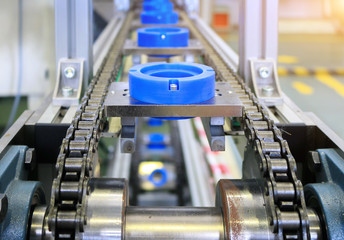
Un convoyeur à chaîne est constitué d’au minimum deux chaînes, mises en parallèle. Celles-ci circulent sur un plat en acier usiné et se voient entrainées par un motoréducteur. Le moteur peut être positionné entre les chaînes ou à l’extérieur du convoyeur.
Quels sont les différents types de convoyeurs à chaîne ?
Les convoyeurs à chaînes peuvent s’intégrer dans les industries de deux façons différentes :
En aérien
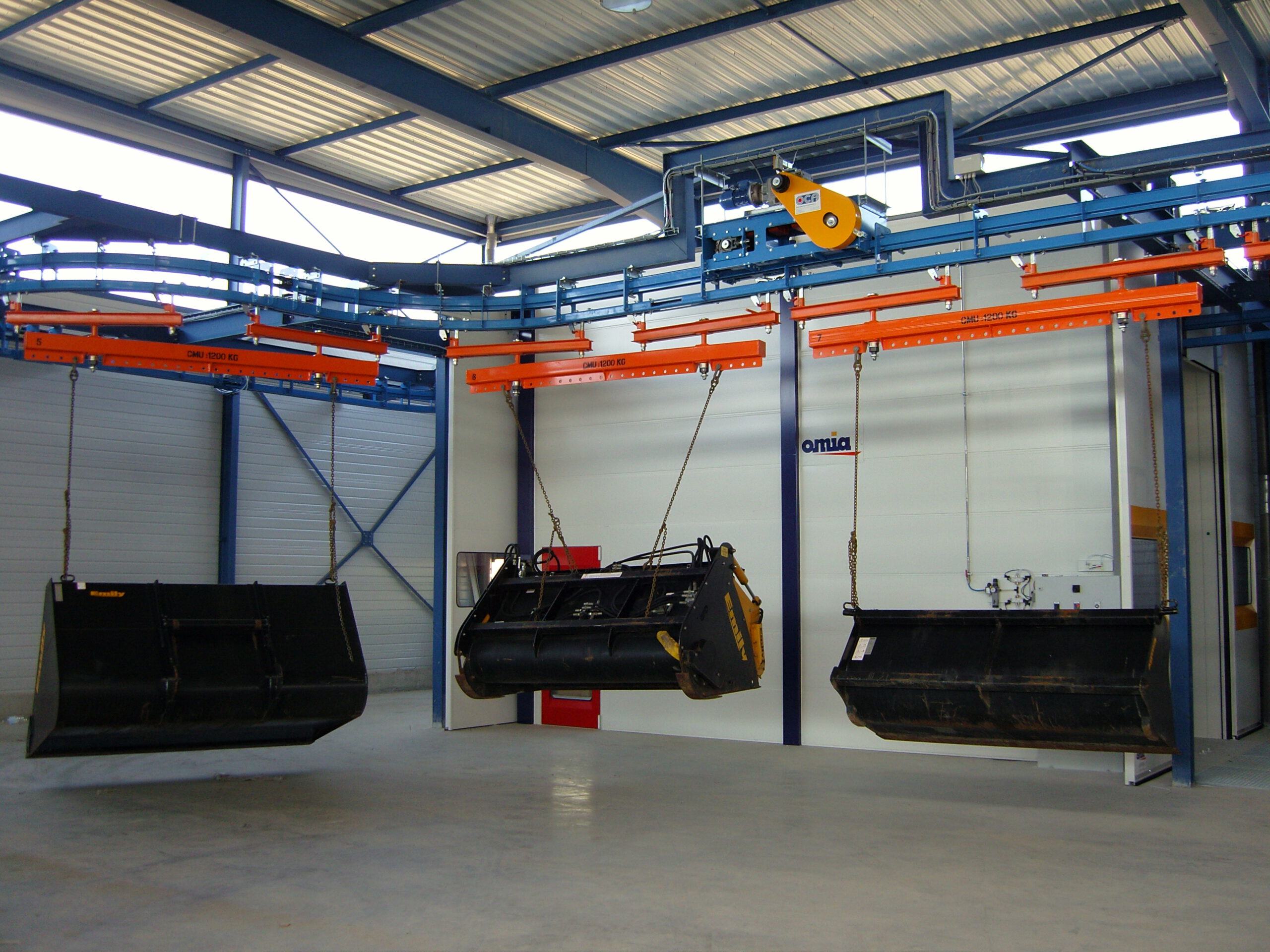
Le convoyeur à chaîne aérien est, comme son nom l’indique, placé en hauteur. Il est fixé sur une charpente métallique. Il optimise l’espace au sol et permet de convoyer ou stocker des charges.
Au sol
Le convoyeur traditionnel se trouve posé au sol, reposant sur des pieds. Il permet l’acheminement de produits, unitaires ou en vrac, variés tels que : des palettes, bouteilles, sacs, cartons, etc.
Quels sont les avantages et les inconvénients d’un convoyeur à chaîne ?
- Avantages d’un convoyeur à chaîne : cette machine robuste, peut être installée à la verticale ou être inclinée ; elle peut permettre une accumulation des pièces à transporter (power and free), ou une manutention en continue.
- Inconvénients d’un convoyeur à chaîne : adapté aux courtes lignes de convoyage, ce système nécessite beaucoup d’énergie puisqu’il fonctionne systématiquement à l’aide d’un motoréducteur. Il peut présenter une usure précoce de la chaîne (liée au frottement des maillons entre eux) nécessitant alors un entretien important.
Quels sont les critères de choix d’un convoyeur à chaîne ?
Le choix d’un convoyeur à chaîne ne se fait pas au hasard ! Pour savoir si ce type de machine correspond à vos besoins, définissez :
- Le trajet du convoyage souhaité (le long de la ligne de production ou de montage),
- La capacité de charge,
- Le type de charge : poids, volume et forme (en vrac ou conditionnée),
- L’espace dans lequel le convoyeur va être intégré. Cet indicateur déterminera le type de convoyeur dont vous aurez besoin (au sol ou aérien).
Le convoyeur à chaîne est généralement intégré dans les secteurs de l’automobile, du traitement de surface et des industries procédant au transport de charges lourdes. On peut également retrouver ce mode de convoyeur dans le secteur de l’agroalimentaire, généralement installé au sol.