Belt Conveyors
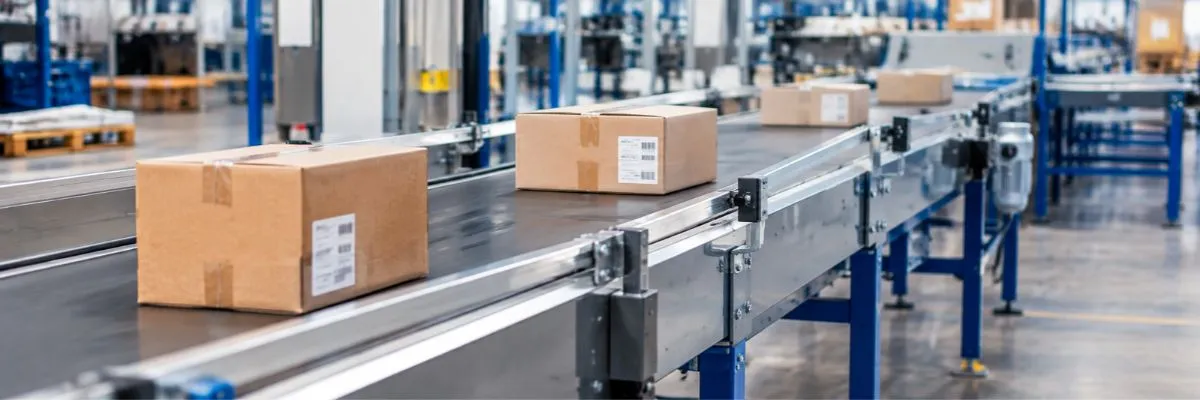
Fragile products, bulk materials or goods requiring consistent grip: some loads cannot withstand the jolts associated with roller or wheel conveyors. A continuous conveying surface that can handle inclines, retain loose materials or meet food-contact requirements helps protect even the most delicate products.
A belt conveyor is designed to meet these requirements. This material handling system consists of a continuous conveyor belt driven by one or more drums, ensuring the smooth, continuous movement of individual items or bulk materials, on horizontal surfaces or inclines.
Ouest Convoyeur & Automatisme (OCA) has been designing and manufacturing these conveyors in France for over 45 years. Our solutions include smooth, cleated, food-grade and rubber belts, tailored to the specific characteristics of the products you need to handle.
Smooth, cleated or food-grade belts: which solution is right for your process?
The choice of belt material and surface depends primarily on the products being conveyed, the line layout and the industrial environment.
For the horizontal conveying of individual items such as cartons, bins or other components, a smooth PVC or rubber belt is generally sufficient. When the application involves an incline, the handling of bulk materials or the need to prevent loads from slipping, a cleated belt fitted with transverse cleats or chevron profiles is required to maintain grip throughout the incline.
In the food processing industry, or wherever the belt comes into direct contact with products, a food-grade polyurethane (PU) belt is suitable for meeting the relevant hygiene requirements.
The frame and drive system must also be considered. A conventional belt conveyor is suitable for fixed production lines, while a telescopic conveyor or a gooseneck belt conveyor can accommodate variable loading points or changes in height, such as lifting products into a hopper, truck or skip.
OCA helps you select the right solution based on your products, the required incline and the installation constraints of your production line.
Our belt conveyors
Smooth belt conveyors
These conveyors use a smooth PVC or rubber belt without surface profiles. They are commonly used for the horizontal conveying of individual items such as cartons, bins, crates, parcels and bottles. They are generally an economical solution for continuous, flat conveying applications.
Cleated belt conveyors
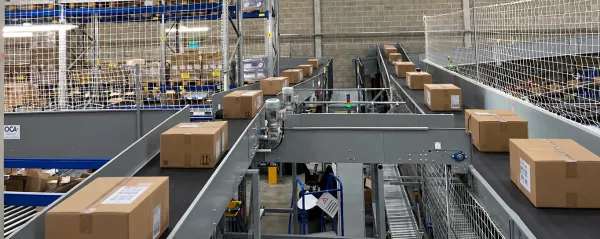
These conveyors feature transverse cleats or chevron profiles attached to the belt to retain products on inclined surfaces.
This type of conveyor is essential when bulk materials need to be elevated or when loads must be prevented from slipping during upward conveying.

Food-grade belt conveyors
These conveyors use a polyurethane (PU) belt, either smooth or lightly textured, designed for applications requiring food contact.
They are also suitable for food processing and packaging lines, as well as environments where frequent cleaning is necessary.

Incline and telescopic belt conveyors
These conveyors are designed to raise products from one level to another. They can feature a straight incline or a gooseneck configuration to accommodate changes in height between workstations.
They are also available in telescopic versions, allowing the conveyor length to be adjusted to suit the discharge point. This option is particularly useful for loading skips and trucks.
At OCA, every configuration is custom-designed to meet your specific requirements, including belt width, belt material, drive system, incline and conveyor length.

Technical spécifications
Specifications | Options and capabilities |
Belt width | Tailored to your needs and installation constraints |
Belt materials | Smooth or cleated PVC, food-grade polyurethane (PU), rubber |
Drive system | End drive, underslung drive or central drive; geared motor, variable speed drive or reeving system, depending on the configuration |
Maximum inclination | Adapted to the belt type and the addition of cleats or chevrons |
Frame | Zinc-plated steel, aluminium, stainless steel or HDPE, depending on the operating environment |
Length | Standard dimensions or custom design |
Applications and industries
Belt conveyors can be integrated into a wide range of industrial environments :
- Logistics: unloading, conveying cartons and handling packaged goods.
- Food processing: integration into packaging lines and applications involving direct contact with food products.
- Pharmaceutical industry: handling lightweight items such as glass or plastic bottles, pipettes, vials and cartons in controlled environments.
- Automotive and other industries: feeding machines, removing products from production lines and transferring components between workstations or production cells.
Their ability to convey bulk materials and operate on inclines makes belt conveyors a complementary solution to roller conveyors, which are particularly suitable for individual loads with a flat, rigid base on horizontal lines.
OCA, a French manufacturer of industrial conveyors for over 45 years
Choosing a belt conveyor starts with choosing the right material handling equipment manufacturer. An incorrectly tensioned belt, an undersized frame for the required incline or a drive system that does not match the actual production rate can all lead to premature wear, additional costs and production line downtime.
For over 45 years, OCA has been manufacturing its belt conveyors in France, taking applicable regulatory requirements into account at every stage, from frame sizing and belt tensioning to selecting the most suitable belt material for the products being handled.
Unlike standardised catalogue products, our custom-designed solutions are developed to provide long-term reliability on your production lines while accommodating your future projects.
Frequently asked questions about belt conveyors
A belt conveyor consists of a continuous belt driven by one or more powered drums and supported by a frame. Products are placed on the belt and move along with it, either horizontally or on an incline.
A smooth belt is suitable for horizontal conveying of individual items. A cleated belt, fitted with transverse cleats or chevron profiles, retains products on an incline and prevents them from slipping during upward conveying.
A belt conveyor moves products along a continuous surface. It is suitable for individual items, fragile products and bulk materials, as well as inclined conveying when the appropriate belt is used. A roller conveyor moves loads along a series of powered or gravity-driven rollers. It is particularly suitable for products with a flat, rigid base, such as cartons, bins and pallets. The right solution depends on the products being handled, the required direction of travel and the constraints of your production line.
A food-grade polyurethane (PU) belt is recommended for applications involving direct contact with food. It is designed to meet the relevant food-contact requirements and is suitable for frequent cleaning, depending on its specifications.
The maximum incline depends on the belt surface and the characteristics of the products being conveyed. A smooth belt limits the achievable incline because of the risk of slipping. A cleated belt with transverse cleats or chevron profiles allows products to be conveyed at significantly steeper angles.
Conveyor belts are most commonly made from PVC, rubber or polyurethane. The appropriate material depends on the products being conveyed, the required wear resistance and any hygiene requirements.
The drive can be positioned at the end of the conveyor, underneath the belt or centrally, using a geared motor. Where required, a variable frequency drive (VFD) can be added to adjust the conveying speed to the desired production rate.
Your project, our expertise
Belt width, material, surface profile, incline and drive system: selecting a belt conveyor involves several parameters that must be defined according to the specific production requirements and constraints of each industrial sector.
The teams at Ouest Convoyeur & Automatisme assess your installation layout and size your belt conveyor according to the products to be conveyed and your production rates. We support you at every stage, from the initial design study through to commissioning.